The Patient Was Always the Brief: Four Decades of Cancer Care Design

When I began my career in healthcare architecture over 40 years ago, a cancer center was defined almost entirely by its equipment. The linear accelerator vault dictated the floor plan. The infusion chair determined the room. The patient, and everyone who loved them, fit in around the edges.
That world no longer exists. The advances in cancer treatment over the past four decades have been staggering, and they have forced a parallel revolution in how we design. Immunotherapy, proton therapy, theranostics, cellular therapy, precision medicine – each breakthrough has rewritten the clinical brief. But the deeper transformation has been human. As treatment has grown more complex, the need to design for patients, families, staff, and caregivers has grown (rightfully) stronger, and our charge is to hold these two truths at once – to design buildings that are technically extraordinary and profoundly humane.
Mass General Hospital, Boston, MA
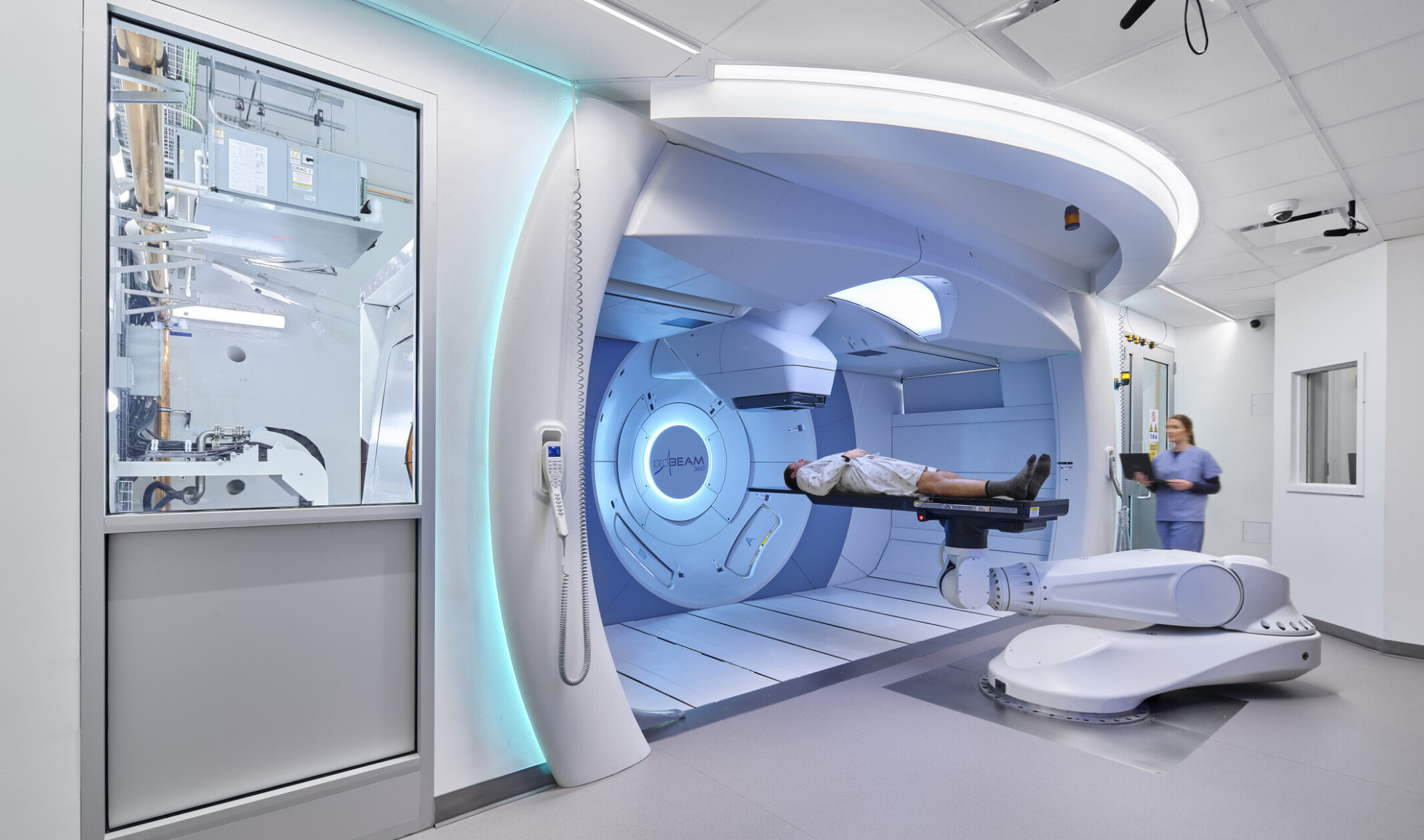
Working with Mass General and IBA in 1993, we designed the first commercial proton therapy treatment center in the United States, a project that forced us to confront a new category of clinical complexity. There was no playbook. The physics of proton delivery required an unprecedented level of coordination between clinicians, engineers, and designers, forcing us to solve problems that had few precedents in the industry. What we learned from that experience was that breakthrough treatments don’t just change medicine, they change the buildings that support it. For the first time, we found ourselves designing not only for the technology we had, but for the innovations we knew were coming.
Penn Medicine, Philadelphia, PA
Penn Medicine gave us our first real opportunity to think at a system scale, designing technology as a connected ecosystem rather than a single innovation, with the patient at the center. The Roberts Proton Therapy Center at the Perelman Center for Advanced Medicine began design in 2006 and was the first academic medical center in the world to fully integrate proton and conventional radiation therapy in a single facility. From that hub, Penn expanded into “spokes” located outside the urban center, making it clear that innovation was no longer measured solely by what happened inside a building, but by how many patients could benefit.
Duke Cancer Center, Durham, NC
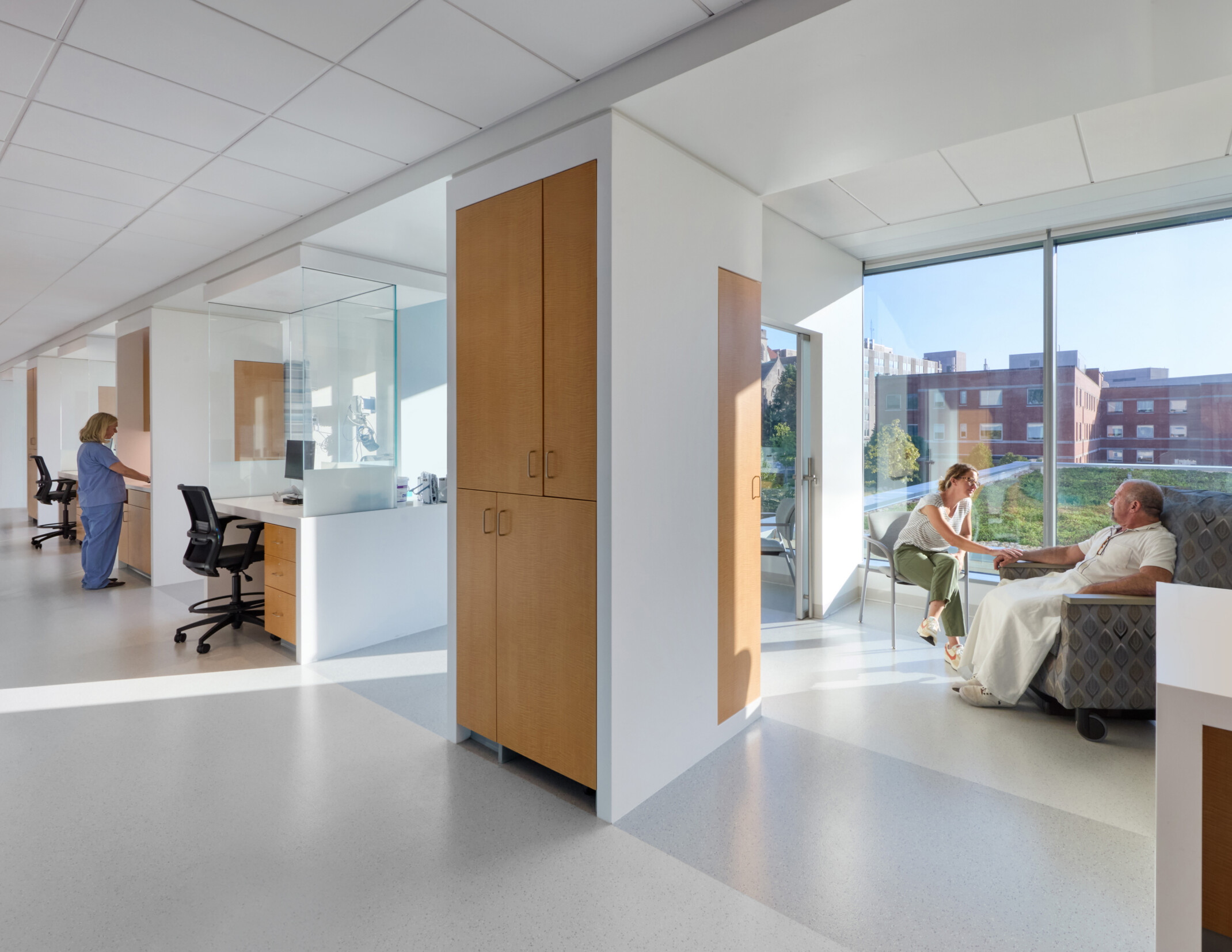
Design for Duke began in 2007 and it was a turning point in how we listened. The patient was now invited into the design process, and our mission was to unify a previously dispersed cancer program into a single, patient-centered environment. Patient advocacy groups shaped everything from wayfinding to the distance between parking and the infusion suite. We learned that a cancer patient carrying fatigue and anxiety measures every step on a campus. The result was a building organized around comfort and choice: a healing garden, a rooftop terrace, a resource room, an atrium filled with natural light, and a campus built for proximity and efficiency.
National Cancer Centre Singapore
In 2014, the government of Singapore asked us to solve a problem that no cancer center had faced: how do you build a 1.5+ million-SF comprehensive cancer center on a constrained urban site and still make it feel calming and personal? The answer was a “central cavern,” bringing shaded outdoor space, natural light, and prevailing breezes deep into a facility that would otherwise have felt institutional and sealed. Research labs were integrated with patient clinics around disease-specific programs, so that a discovery made in the morning could inform a clinical decision in the afternoon, evidence of how quickly the boundaries between research and care were disappearing.
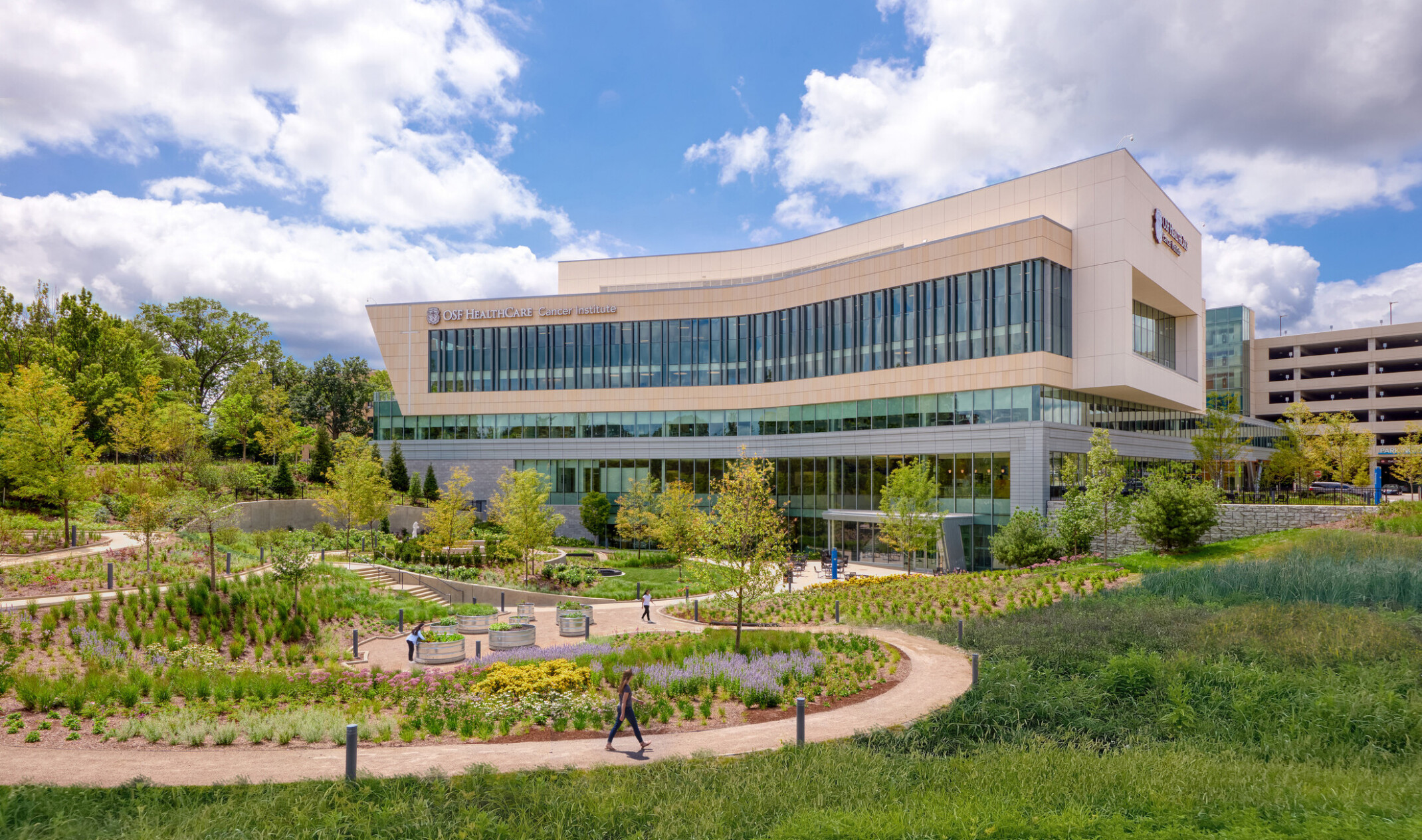
OSF Cancer Institute and Proton Therapy Center, Peoria, IL
OSF presented a different challenge in 2019: bringing world-class cancer care to a community that had historically traveled hours to access it. We often talk about the burden of cancer in clinical terms, but for many patients, the burden is also measured in miles, time, and disruption to daily life. The design uses the metaphor of changing seasons and a path toward a garden to give patients a symbolic framework for their journey. A teaching kitchen, survivorship programming space, and a healing garden bring the whole person into the building’s program – prioritizing wellness and prevention as well as treatment.
The Next Evolution
Even as I write this, progress continues. In fact, DLR Group is undertaking the most clinically complex cancer facility I have worked on to date. The program brings surgery, diagnosis, therapy, theranostics, and cellular therapy together in a single NCI-designated center – the most complete menu of care choices we have ever been asked to house, requiring a complete reimagining of what the patient experience can be. When treatment is this intensive, the space itself must counterbalance the medicine, acknowledging the whole person, not just the diagnosis.
Forty years in, the question I ask at the start of every project is the same: What do patients need to feel that they are in capable, caring hands? The clinical answer changes with every research breakthrough. The human answer does not. We must not only treat cancer but also sustain the people who are living through it. That is what advances in cancer treatment demand of us.
Learn more about DLR Group’s cancer care experience.
Ideas
Recommended Reads